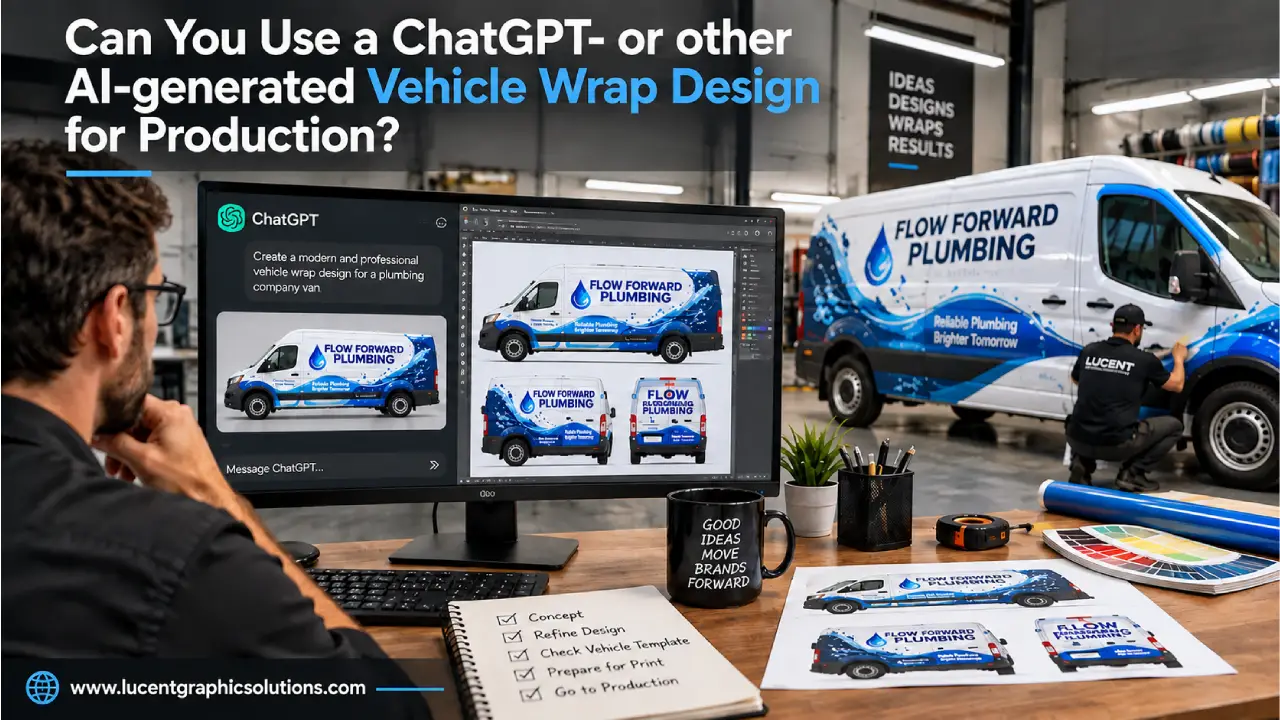
Yes, but an AI-generated vehicle wrap design usually needs professional preparation before production. AI can create a strong concept, layout, or visual direction, but the final design should be rebuilt or refined as a high-resolution, print-ready file with accurate dimensions, bleed, panel lines, and correct color settings. A professional wrap designer should also check the artwork against the actual vehicle template before sending it to print.
Why an AI-Generated Vehicle Wrap Is a Concept — Not a Production-Ready Design
Artificial intelligence tools such as ChatGPT have made it incredibly easy to visualize ideas. You can upload a photo of a van, describe the type of vehicle wrap you have in mind, specify colors and styles, and within minutes receive an impressive-looking rendering.
That can be a great way to explore ideas.
The problem begins when an AI-generated vehicle wrap image is treated as though it were a completed design that can simply be sent to a wrap shop, printed, and installed.
It can’t.
At Lucent Graphic Solutions, we are increasingly receiving AI-generated vehicle wrap concepts accompanied by requests to “just print this” or “make the wrap exactly like this.”
Unfortunately, an AI-generated image is not a vehicle wrap production file. It is a visual concept, and there is a significant amount of professional design and production work required to turn that concept into an actual vehicle wrap.
1. ChatGPT Creates an Image, Not a Production File
This is the most important distinction.
A professional vehicle wrap design isn’t simply a picture of what the finished vehicle should look like. The designer must create actual artwork that can be printed at full vehicle size.
A production-ready wrap file needs to account for:
· The exact vehicle make and model
· Model year
· Wheelbase
· Roof height
· Cargo vs. passenger configuration
· Doors and door openings
· Windows
· Handles
· Hinges
· Body seams
· Wheel wells
· Lights and reflectors
· Fuel doors
· Body contours
· Installation overlaps and bleed
· Areas where vinyl cannot or should not be installed
The artwork also needs to contain sufficiently high-resolution raster imagery and/or properly constructed vector graphics.
An AI-generated rendering does none of this.
It creates an image showing what a vehicle might look like with a particular design.
That’s very different from creating the artwork necessary to actually wrap that vehicle.
2. The Vehicle in the AI Rendering May Not Even Be the Correct Vehicle
This is one of the biggest problems we encounter.
A customer may ask AI to design a wrap for a Ford Transit, Mercedes-Benz Sprinter, RAM ProMaster, or another commercial vehicle.
The resulting image may look convincing at first glance.
But look closer.
· The wheelbase may be wrong.
· The roof height may be wrong.
· The windows may be different.
· The doors may be positioned differently.
· The body lines may not match.
· The headlights and taillights may be from another model.
In some cases, the AI-generated vehicle is essentially a fictional combination of several different vans.
For example, a customer may own a Ford Transit 148” Extended High Roof, while the AI-generated concept shows proportions closer to a completely different Transit configuration—or even incorporates features from another manufacturer.
That matters enormously when designing a wrap.
A graphic positioned perfectly behind the rear wheel in an AI rendering may land directly across a door seam on the actual vehicle.
A logo shown centered beautifully on the side may end up crossing a body contour.
Text shown above a wheel well may not physically fit in that location.
The AI is creating an aesthetically pleasing image. It isn’t engineering artwork around the exact physical dimensions of your vehicle.
3. AI Does Not Design the Wrap at the Correct Scale
Vehicle wrap artwork is enormous.
A commercial van can require artwork measuring hundreds of inches across. Professional wrap designers work from scaled vehicle templates and/or actual vehicle measurements so artwork can eventually be enlarged and printed at the correct physical dimensions.
An AI-generated concept doesn’t work that way.
There isn’t a hidden 200-inch-wide production file behind the image you see on your screen.
The AI has generated a relatively small digital image representing the vehicle.
Making that image larger doesn’t magically turn it into production artwork.
It’s similar to taking a screenshot of a billboard and expecting a printer to enlarge the screenshot to 40 feet while maintaining perfect quality.
The visual may communicate the idea, but the underlying production information simply isn’t there.
4. “Can You Just Recreate It Exactly?” Is Often Much Harder Than It Sounds
This is another common request:
“I know you can’t print the ChatGPT image. Can your designer just recreate it exactly?”
Sometimes we can create something similar.
But recreating it exactly may be extremely difficult—and sometimes impossible.
Why?
Because AI-generated imagery often contains visual elements that don’t actually exist as individual design assets.
For example, an AI concept may contain:
· Custom textures
· Abstract patterns
· Complex gradients
· Artificial lighting effects
· Distorted logos
· Invented typography
· Illustrations that don’t exist anywhere else
· Background imagery blended together by the AI
· Shapes that change unpredictably around the vehicle
· Details that look different from one side of the vehicle to another
There may be no original Photoshop file.
· No Illustrator file.
· No vector pattern.
· No font.
· No original photograph.
· No separate background.
· No layers.
There is simply a flattened AI-generated image.
Our designer therefore isn’t “opening the file and adjusting it.”
We may essentially have to design the wrap from scratch while attempting to reverse-engineer an image created by artificial intelligence.
That can require considerably more design time than creating an original professional wrap design from the beginning.
And even after doing that work, the finished production design may not look exactly like the AI-generated rendering.
5. AI Doesn’t Understand How a Flat Graphic Wraps Around a Three-Dimensional Vehicle
This is where professional vehicle wrap experience becomes especially important.
A van isn’t a flat rectangle.
It contains compound curves, recessed areas, protrusions, body lines, doors, seams, wheel wells and transitions between panels.
The wrap, however, begins as flat printed vinyl.
A professional designer has to anticipate what happens when that flat artwork is installed onto a three-dimensional object.
That means understanding things such as where important text should be positioned, where logos can safely fall, how graphics transition between panels, and which portions of an image may disappear around a curve or into a door opening.
An AI-generated rendering only needs to make the vehicle look good in the image it generates.
It doesn’t need to figure out how an installer is actually going to put that artwork on the vehicle.
Those are two completely different problems.
6. What Looks Perfect in a Rendering May Be Impossible on the Actual Vehicle
AI concepts frequently show logos, text and graphics positioned perfectly between body lines.
Unfortunately, the real vehicle may not allow that placement.
Customers sometimes ask us to guarantee that every element will avoid every:
· Body line
· Curve
· Crease
· Door seam
· Handle
· Hinge
· Wheel well
· Recess
With many vehicle designs, that’s simply impossible.
Vehicle wraps are large-format graphics covering complex three-dimensional surfaces. Depending on the design, certain graphics will inevitably cross contours or body lines.
A professional mockup is intended to provide a reasonably accurate representation of placement, but even a professional 2D template cannot perfectly reproduce every three-dimensional contour of an actual vehicle.
That’s why we encourage customers to compare the design proof with their actual vehicle before approving artwork.
7. AI-Generated Text and Logos Are Another Major Problem
AI image generators are much better than they used to be, but they can still alter text, logos and brand elements.
A company logo may look correct at first glance while actually having slightly different proportions.
A font may resemble your corporate font without actually being that font.
Letters may be distorted.
Spacing may be inconsistent.
A logo that looks sharp in the rendering may only occupy a few hundred pixels in the actual generated image.
Professional vehicle graphics require the original brand assets whenever possible.
Ideally, logos should be supplied as vector artwork, and fonts should be identified or converted appropriately. Photographic elements need sufficient resolution for large-format reproduction.
“Just use the logo from the AI image” is generally not an acceptable production solution.
8. There Is a Big Difference Between a Mockup and Artwork
This distinction existed long before AI.
A mockup shows approximately what a finished vehicle could look like.
Production artwork is what the printer and installer actually use to create it.
ChatGPT and other AI image-generation tools can be very effective at producing mockups and visual concepts.
But the mockup should be treated as inspiration—not as the production file.
Think of an AI-generated vehicle wrap like an architectural rendering of a house.
A beautiful rendering can show you the style, colors and appearance of the finished home.
But you wouldn’t hand that rendering to a contractor and say:
“Build this exactly.”
The contractor still needs architectural plans, engineering, dimensions, specifications and construction drawings.
Vehicle wraps work much the same way.
9. AI Can Still Be a Very Useful Tool for Vehicle Wrap Design
None of this means we’re against using ChatGPT or AI to develop ideas.
Quite the opposite.
AI can be extremely useful during the conceptual stage.
If you’re not sure what style you want, AI can help you explore:
· Color combinations
· General layouts
· Visual themes
· Bold vs. minimalist concepts
· Industry-specific imagery
· Background styles
· Different creative directions
If you bring us an AI-generated concept and say:
“I really like this direction. Can you use this as inspiration for my wrap?”
That’s useful.
It gives our designer a visual reference for what you’re trying to achieve.
The important distinction is that we then need to create an actual wrap design based on your specific vehicle, your real branding assets and the requirements of large-format production and installation.
10. Expect Professional Design Work Before Production
If you provide an AI-generated vehicle wrap concept, there should be an expectation that professional design work will still be required.
Depending on the complexity of the concept, that may involve:
· Rebuilding the layout
· Recreating backgrounds and patterns
· Sourcing or creating suitable imagery
· Rebuilding graphic elements
· Incorporating your actual vector logos
· Using the correct fonts
· Adjusting proportions
· Designing on the correct vehicle template
· Accounting for the actual vehicle configuration
· Preparing print-quality artwork
· Creating production panels
· Adding necessary bleed and overlaps
· Making installation-specific adjustments
In other words, the AI image is the starting point—not the finished product.
11. Why We Cannot Guarantee an Exact Recreation of an AI Design
If you bring us an AI-generated wrap concept, we can evaluate it and determine whether the overall design direction can be recreated.
However, we cannot guarantee an exact reproduction.
The final design may need to change because of:
· The actual dimensions of your vehicle
· Differences between the AI vehicle and your vehicle
· Image-resolution limitations
· Unavailable fonts or graphics
· Body lines and vehicle contours
· Door and window placement
· Production requirements
· Installation limitations
· Elements generated by AI that cannot practically be reconstructed
Our goal isn’t to make the production artwork match an unrealistic rendering at any cost.
Our goal is to take the idea behind the rendering and turn it into a professional vehicle wrap that looks great on the actual vehicle and can actually be printed and installed correctly.
The Bottom Line
A ChatGPT-generated vehicle wrap design is a concept, not a production-ready wrap file.
It can be a fantastic way to communicate an idea.
It can show us a style you like.
It can help establish colors, mood and creative direction.
But it cannot simply be handed to a professional wrap company and printed onto your vehicle.
The vehicle shown may be the wrong model, wrong wheelbase or wrong roof height. The artwork isn’t created at scale. Individual graphic elements may not exist as usable files. The image may not have sufficient resolution. And the layout may not physically work on the real vehicle.
Turning that concept into an actual wrap requires a professional designer to recreate, adapt and prepare the artwork specifically for your vehicle and for large-format production.
So if you’ve created a vehicle wrap concept using ChatGPT, absolutely bring it with you.
Just bring it as an idea—not as a finished design.
At Lucent Graphic Solutions, we can use your AI-generated concept as a visual reference and determine what can realistically be translated into a professionally designed, production-ready vehicle wrap.
 (877) 582 3680

 (877) 582 3680