Home » Wall Graphics for Restaurants That Create Memorable Dining Experiences

Wall Graphics for Restaurants That Create Memorable Dining Experiences

Restaurant Wall Graphics Guests Love and Competitors Notice

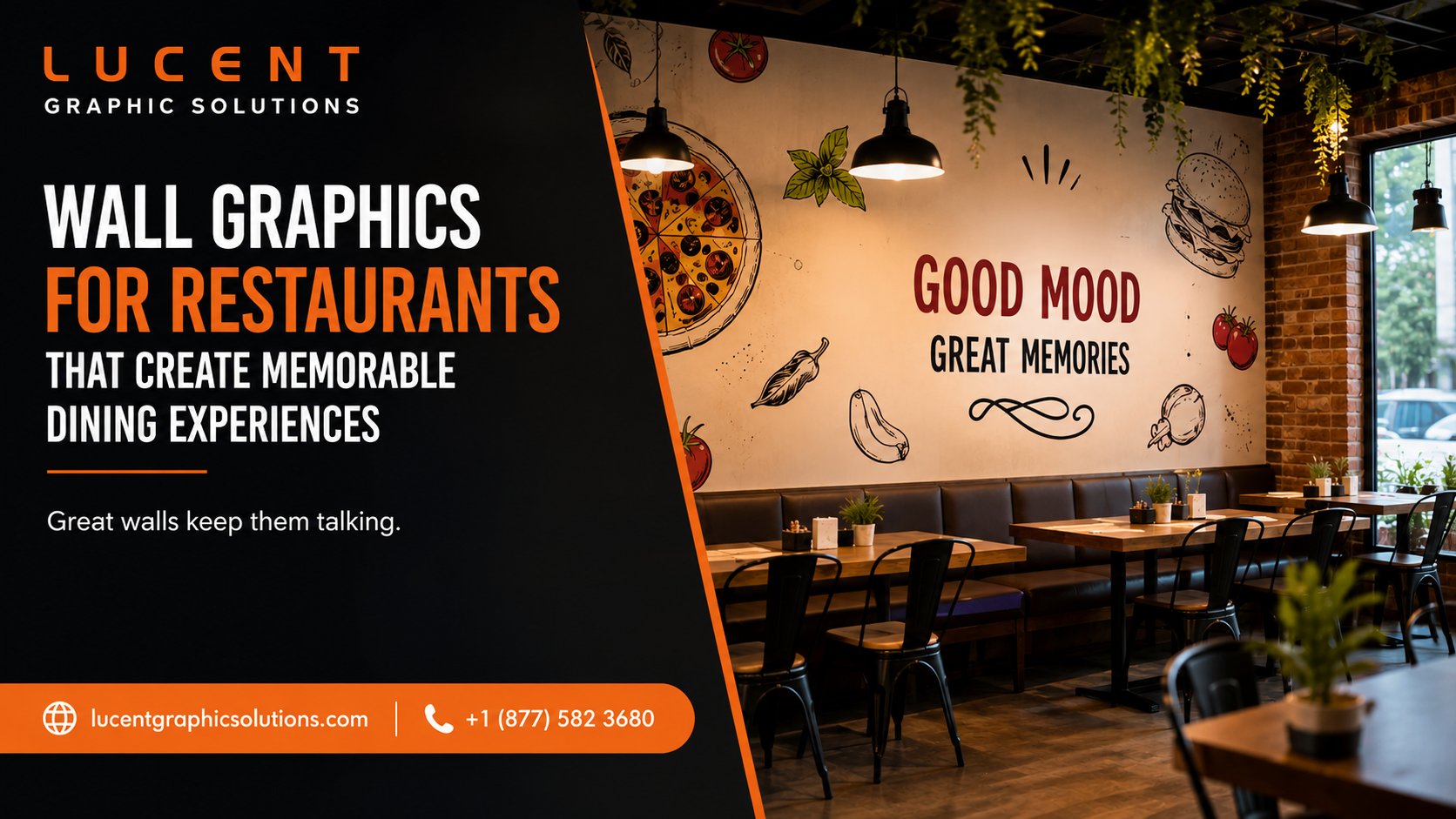
Wall graphics for restaurants change the way a dining room feels the second a guest walks in, before the food even hits the table. We’ve installed these across enough Orange County restaurants to see the pattern: a bare wall reads as unfinished, and a well-designed one reads as intentional. This blog covers what actually works inside a working restaurant, what it costs, and how the install happens around a kitchen that never really stops.

What Are Wall Graphics for Restaurants?

They are printed vinyl murals, wraps, or decals applied to interior walls to build atmosphere, reinforce a concept, or tell a brand’s story. They function as a design layer between paint and full architectural buildout, without the cost or downtime of a remodel.

Restaurants use them behind bars, in dining rooms, along hallways to restrooms, and inside private event spaces.

Why Do Restaurants Need Custom Wall Graphics?

A restaurant sells atmosphere as much as it sells food, and a plain wall does nothing to support that. Custom wall graphics for restaurants give a dining room personality that a menu alone can’t communicate. We worked with a taco spot in Tustin that had exposed drywall behind its bar for over a year after opening. After we installed a mural referencing the owner’s hometown market, servers told us guests started asking about the story behind it almost every shift.

That reaction matters more than it sounds. A wall people ask about is a wall that gets talked about outside the restaurant too, on social media and in conversation. If your dining room has one wall guests face while seated, that’s the wall worth investing in first. Skipping it and spending the same budget on more menu items rarely produces the same effect.

How Do Restaurant Wall Murals Enhance the Dining Experience?

Restaurant wall murals enhance the dining experience by giving guests something visually engaging to look at during the wait between ordering and being served. They reinforce a restaurant’s concept in ways a logo alone cannot, whether that’s a coastal theme, an old-world Italian feel, or a modern minimalist look. Well-placed murals also create a natural photo backdrop, which extends your reach past the people actually sitting in the room.

Here’s the tradeoff worth knowing upfront: a mural near an open kitchen or wood-fired oven needs heat-tolerant material, or the print will discolor within months. We spec differently for a quiet dining room wall than we do for anything within ten feet of a grill line. Ask your installer directly which zones in your restaurant need that upgrade before you approve a single design.

What Are the Best Restaurant Wall Graphics Ideas?

The best restaurant wall graphics ideas match the story your restaurant is already telling through its food and service, rather than competing with it. Below are the four concepts we get asked for most often, in the order restaurant owners tend to request them.

Menu-Inspired Accent Walls

These pull visual elements straight from your dishes: an illustrated ingredient map, a hand-drawn version of a signature plate, or typography built around your most-ordered item. They work best behind a host stand or open kitchen pass, where waiting guests have time to look. Keep the color palette tied to your actual branding, not just whatever looks good printed.

Neighborhood and Local Story Murals

A mural referencing your city, neighborhood, or a specific local landmark gives out-of-town guests context and gives regulars a sense of ownership. A brewery client in Santa Ana used a mural of the original building’s facade from the 1940s, and regulars now reference it by name when describing the space to friends. This is the option we recommend most for restaurants trying to build a neighborhood following rather than pure tourist traffic.

Branded Logo and Typography Walls

A large-format version of your logo or a typographic wall built around your restaurant’s name works well near an entrance or host stand, where it reinforces the brand the moment guests walk in. Keep it simple. A logo wall crowded with taglines and secondary graphics loses the clean impact that makes this option work in the first place.

Private Dining and Booth Wall Graphics

Smaller-scale graphics inside private dining rooms or booth seating add texture without overwhelming an intimate space. We’ve installed subtle pattern work, framed-looking vinyl “art,” and soft typography in these spots for clients who want something quieter than a full mural. These areas also tend to get the least foot traffic wear, so more delicate finishes hold up fine here.

Restaurant Wall Graphics Options Compared

This table compares the restaurant wall graphics formats our crew installs most often, matched to where in the restaurant they tend to work best.

Graphic Type Typical Lifespan Best Placement Approx. Install Time
Concept mural 4–6 years Main dining wall, bar backdrop 1–2 days
Local story/neighborhood mural 4–6 years Entry, waiting area 1 day
Logo/typography wall 5–7 years Host stand, entrance Half day
Private dining/booth decal 5–7 years Booths, private rooms 2–4 hours

How Much Does Restaurant Wall Graphics Installation Cost?

Restaurant wall graphics installation cost depends mainly on square footage, wall condition, and whether the zone needs heat- or grease-resistant laminate. A single accent wall in a standard dining room typically costs less than comparable framed artwork once print, material, and labor are bundled together. Kitchen-adjacent walls cost more because the material has to survive heat, steam, and repeated cleaning with commercial degreasers.

We won’t quote a flat number without seeing the space, and any installer who does before seeing photos is guessing. A wall behind a bar in an older building with uneven plaster takes longer to prep than smooth drywall in new construction, and that time shows up in your invoice either way.

How to Install Wall Graphics in a Restaurant

  1. Measure the wall and mark all outlets, sconces, and vents.
  2. Confirm ventilation and grease exposure levels near the install zone.
  3. Clean the surface fully to remove grease film and residue.
  4. Choose laminate rated for the wall’s specific heat exposure.
  5. Schedule the install around closed hours to avoid service disruption.
  6. Apply the graphic from one edge, smoothing bubbles as you work.
  7. Inspect all edges again after 24 hours for lifting or gaps.

Restaurants that skip step two are the ones who call us back within a year asking why their mural is peeling near the kitchen pass. Grease particulates travel further than most owners expect, even with working exhaust hoods. The International Sign Association publishes general installation standards worth reviewing if you want a reference beyond a single installer’s process.

What Materials Work Best for Commercial Wall Graphics in Restaurants?

Commercial wall graphics for restaurants generally use cast vinyl with a grease-resistant laminate in kitchen-adjacent zones, and standard laminate everywhere else. Cast vinyl handles the temperature swings near ovens and grills better than calendered vinyl, which can warp under sustained heat. Dining rooms without direct kitchen exposure can use lighter laminate since they face less grease and steam.

We steer every client with an open kitchen concept toward the heavier-duty laminate, even when it costs more upfront. A pizzeria in Fullerton learned this the hard way after their first install, done by another company with standard laminate, started bubbling near the wood-fired oven within four months. We re-did that wall with heat-rated material, and it’s held up two years since.

How Does Restaurant Branding with Wall Graphics Build Repeat Customers?

Restaurant branding with wall graphics builds repeat customers by giving guests a visual identity to associate with your restaurant beyond the food itself, which strengthens recall when they’re deciding where to go next. A distinctive wall becomes shorthand for the whole experience in a guest’s memory. This matters most in markets with heavy competition, where several restaurants might serve similar food at similar prices.

We’d recommend treating your wall graphics as part of your actual brand system, not a decoration added after everything else is finished. Restaurants that involve their designer or install crew early tend to end up with walls that match their logo, menu design, and overall tone. Restaurants that treat it as an afterthought often end up redoing the work within a year because it doesn’t fit.

Best Practices for Restaurant Wall Graphics Installation in Orange County

Restaurant wall graphics installation Orange County crews handle needs to account for coastal humidity near spots like Newport Beach and Huntington Beach, which behaves differently than the drier heat inland around Anaheim or Irvine. Humidity affects how long vinyl adhesive takes to cure and how well it bonds to older plaster common in coastal strip malls. We test adhesion on a small section before a full install anywhere within a few miles of the coast, including a seafood restaurant we worked on near the Newport pier.

Restaurants operating in older Orange County buildings should also expect more wall prep time than a newer build requires. Uneven plaster, old paint layers, and inconsistent surfaces are common in restaurants converted from older retail spaces, and skipping the prep step to save a few hours almost always shows up as bubbling within the first year.

The Bottom Line

If you’re deciding between a plain painted wall and something more deliberate, we’d point you toward wall graphics for restaurants for any space guests actually look at while seated or waiting. Paint alone won’t carry your concept the way a well-designed mural or accent wall can. We’ve helped restaurant owners across Orange County turn an ordinary dining room into the kind of space guests describe to friends before describing the food.

If you’d like to see what wall graphics could look like in your restaurant, reach out to our team for a walkthrough and a no-obligation mockup of your actual dining room. You can get in touch through our contact page, call us at 877-582-3680, or email info@lucentgraphicsolutions.com. We’ll look at your space, including kitchen-adjacent walls, before recommending any material or design.

Related reading: our comparison of custom wall wraps versus paint, our piece on why wall graphics beat paint every time, and how smart businesses are using custom wall graphics to stand out. We’ve also covered wall wraps for business branding, office wall murals for businesses if you manage mixed-use commercial space, wall graphics for gyms for a look at another atmosphere-driven install, and wall lettering for business if simple typography fits your concept better than a full mural.

Common Questions About Wall Graphics for Restaurants

How long do wall graphics last in a restaurant?

Vinyl wall graphics for restaurants typically last 4 to 6 years in high-humidity or kitchen-adjacent zones, and 5 to 7 years in dry dining areas away from heat and grease exposure.

Can restaurant wall graphics handle grease and steam?

Yes, when installed with grease-resistant laminate rated for kitchen exposure. Standard laminate without that rating will discolor or bubble faster near open cooking areas.

Do wall murals work in small restaurants or cafés?

Yes, smaller spaces often benefit more since a single well-placed mural can define the entire room’s character. Scale the design down rather than cramming a large-format concept into a tight space.

How much does custom restaurant wall graphics installation cost?

Cost depends on square footage, wall condition, and proximity to heat or grease sources, so a credible quote requires photos or an in-person visit. Be cautious of flat per-square-foot pricing quoted sight unseen.

What's the difference between wall wraps and wall murals for restaurants?

Restaurant wall wraps typically cover an entire wall or large surface in one continuous design, while murals can be sized to a single accent area. Both use printed vinyl, but wraps usually involve more precise measuring around obstructions.

Should restaurants update wall graphics seasonally?

Most restaurants keep concept murals in place for years rather than swapping seasonally, unlike retail promotional graphics. Menu boards or small seasonal accents are better suited to frequent changes than a full mural.

Is professional installation necessary for restaurant wall graphics?

Professional installation matters most for kitchen-adjacent walls and large-format murals, where heat exposure and precise alignment are harder to manage without experience. Smaller decals in low-traffic dining areas are more forgiving for an in-house attempt.