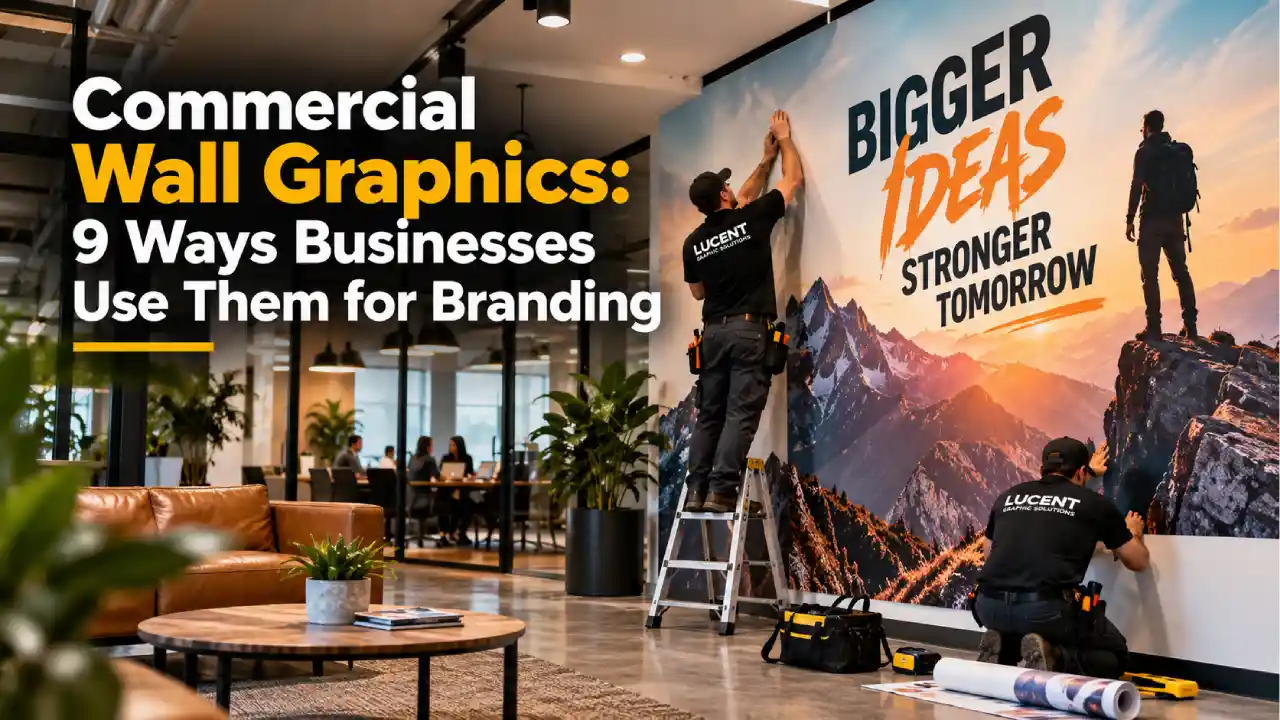
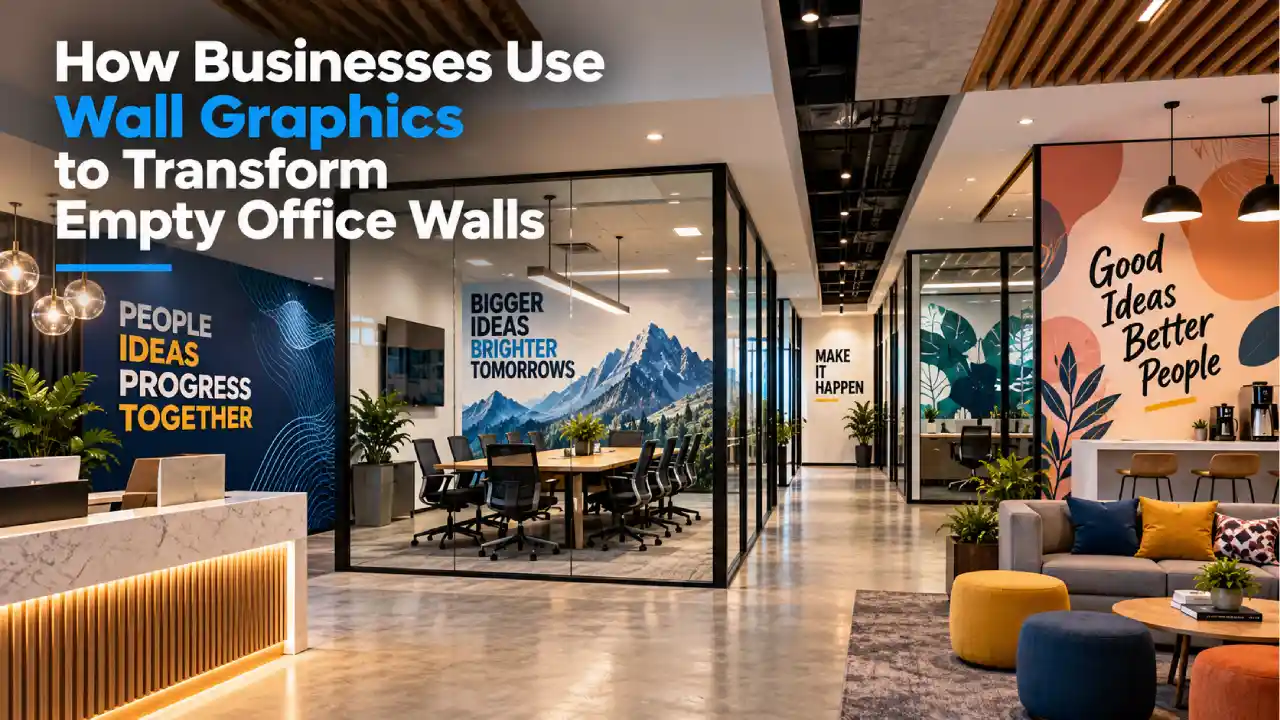
Commercial wall graphics are large printed or cut vinyl graphics installed on the interior walls of offices, stores, clinics, hotels, and restaurants. Businesses use them to put their brand on the walls people look at every day: a logo wall in reception, a values wall in the break room, a product story at the back of a store, or color-coded wayfinding in a medical building. Most are printed on adhesive film or wallcovering and laminated wherever people touch or clean the wall.
Lucent Graphic Solutions has designed, printed, and installed custom wall graphics for commercial spaces from our Costa Mesa location since 2006. Our clients include offices, retailers, medical practices, restaurants, educational and property managers in Irvine, Newport Beach, Anaheim, Huntington Beach, and the rest of Orange County. The nine uses in this blog are the ones they ask us about most.
Commercial wall graphics are custom printed or cut graphics applied to walls in business settings, including offices, retail stores, healthcare facilities, hotels, and restaurants. They can be a single logo or a floor-to-ceiling mural, made from adhesive film, laminate, or printed wallcovering chosen for the wall surface and the wear it will get.
9 ways businesses use commercial wall graphics for branding
1. Lobby and reception walls for corporate offices
The wall behind the front desk is the first branded surface most visitors see, so it’s where most corporate offices start. A large logo, a company timeline, or a mural of the product in use all work here.
We usually recommend a matte finish for lobby graphics. Many Orange County lobbies have big windows and strong overhead lighting, and a gloss finish throws glare that can wash out a logo seen from the entry door. Matte laminate keeps the colors readable from across the room.
2. Culture and values walls in office interiors
Commercial wall graphics for offices often carry a mission statement, company values, or team photos. Where you put them matters more than the wording. A break room gets looked at every day, while a boardroom might be used twice a week.
If the budget covers one culture wall, put it where people take their coffee. Cut vinyl lettering suits values statements because it reads cleanly and costs less than a full printed wall. For bigger artwork, our guide to office wall murals for businesses covers mural types and design choices.
Take a 40-person software company in Irvine with two years left on the lease for its second-floor suite. The team wants a mural in reception and values lettering in the kitchen, and the lease says walls go back in original condition. For a project like that we’d print the mural on removable film rated for painted drywall, cut the lettering from removable vinyl, and get the landlord’s sign-off before install.
3. Feature walls for retail stores
Commercial wall graphics for retail stores do the most work on the back wall, since shoppers see it from the entrance and walk toward it. A lifestyle image behind new arrivals, or a wall that explains how the product is made, gives people a reason to cross the whole floor.
Retail graphics also change more often than office graphics. For promotions that rotate with the seasons, we recommend removable film so the next campaign goes up without repainting. Our article on wall wraps for retail stores goes deeper on placement and promo rotation.
4. Wayfinding graphics for commercial buildings
Medical buildings, office campuses, and schools use wall graphics to help people find their way. A colored band running the length of a corridor, oversized floor numbers at the elevator, and large department names all help a first-time visitor.
Permanent room signs are a separate job. Under the 2010 ADA Standards for Accessible Design, signs that identify permanent rooms, such as restrooms and exam rooms, need raised characters and braille, while directional signs must meet the visual character rules in Section 703.5. We recommend keeping ADA room plaques at each door and letting the wall graphics handle color zones and large directional cues.
5. Waiting rooms and corridors in healthcare facilities
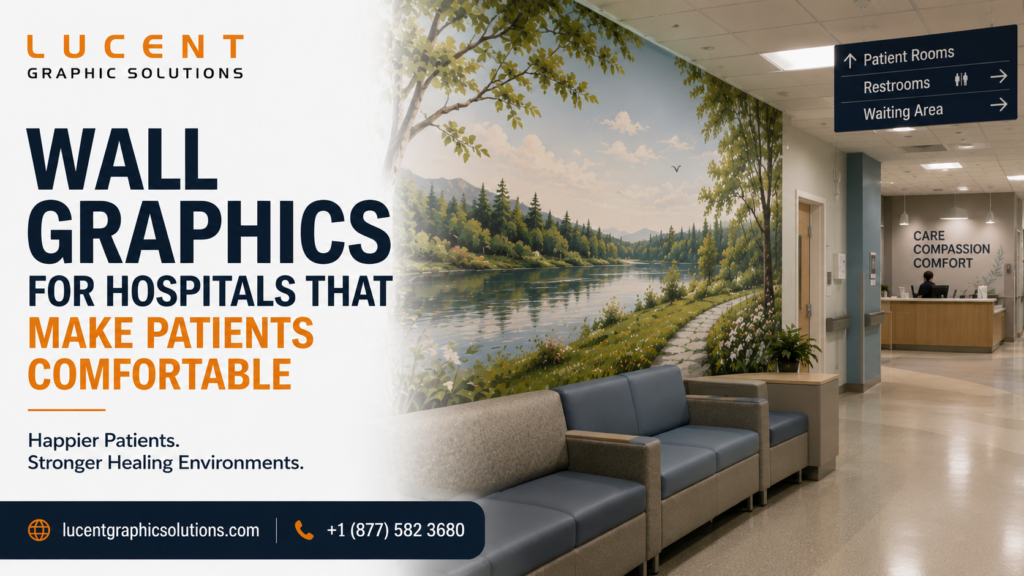
We print with UV-cured inks certified for low chemical emissions, and we recommend a cleanable laminate on any wall within reach of patients. Our guide to wall graphics for hospitals covers infection control and fire-code questions in more detail.
Suppose an urgent care clinic in Costa Mesa wants to brand its waiting room and help patients find three exam hallways. A practical plan is one mural wall facing the check-in desk, a different color band in each hallway, and standard ADA signs at every door. Anything within reach of hands, chair backs, and cleaning carts gets the cleanable laminate.
6. Concept walls for restaurants
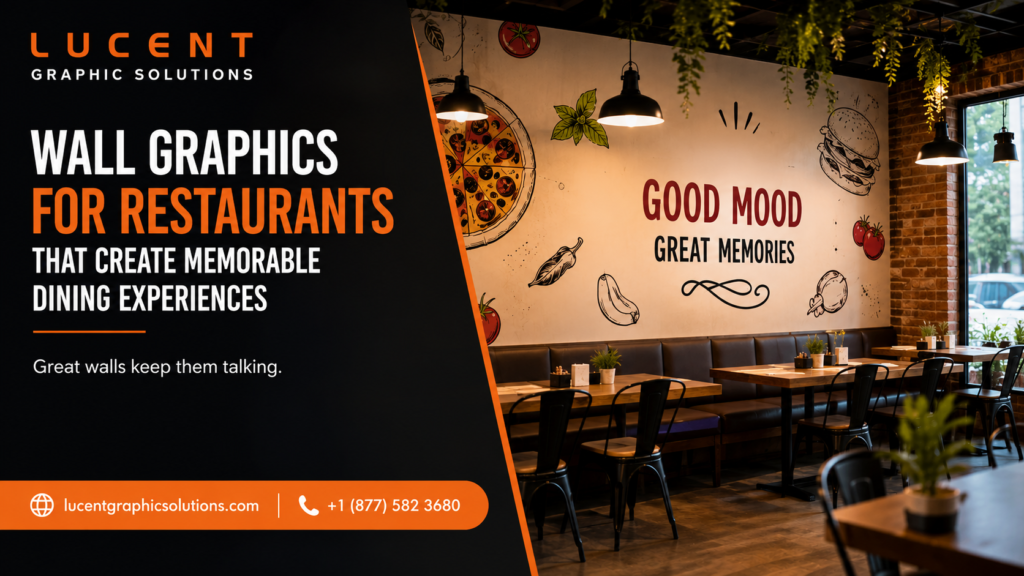
Commercial wall graphics for restaurants usually carry the concept. That might be a hand-drawn map of the neighborhood, oversized ingredient photos, or a mural that makes a strip-mall location feel like it belongs somewhere specific.
Restaurant walls take more abuse than office walls. Heat and grease near the kitchen pass or a pizza oven shorten the life of an unlaminated print, so we recommend laminated film and keeping the mural back from direct heat. Most owners keep a concept mural for years, which makes a longer-life material worth the extra cost. See wall graphics for restaurants for placement ideas.
7. Lobbies and guest corridors in hotels
Commercial wall graphics for hotels tend to cover long runs of wall: corridors, elevator landings, and lobby feature walls. For long corridors we recommend printed wallcovering over adhesive vinyl. It hangs in panels like wallpaper, so seams land in predictable places along a 100-foot hallway, and it can carry a paper or fabric texture that suits a hotel interior.
Ask for fire-rating documentation on the wallcovering before you approve samples. Interior finishes in hotels and other commercial buildings fall under the California Building Code, and building managers often want those papers before work starts. We print custom wallcovering in-house for these projects.
8. Educational Use for Schools and Universities
Schools and universities can use custom wall graphics to transform ordinary hallways, classrooms, libraries, athletic facilities, and common areas into engaging educational and inspirational spaces.
Wall graphics can feature school history, timelines, notable alumni, academic achievements, school values, donor recognition, athletics, or subject-specific educational content. Large-scale graphics can also help reinforce school identity and create a stronger sense of pride and connection for students, faculty, families, and visitors.
For educational facilities, we recommend durable commercial-grade wallcoverings or vinyl selected specifically for the surface, location, and expected level of traffic.
9. Leasing offices, pop-ups, and vacant suites
Property managers use commercial wall graphics to make leasing offices and empty suites look cared for. Brands use them for pop-up shops and event walls that come down after a few weeks. Both need graphics that go up fast and come off clean.
A property manager in Tustin preparing a vacant retail suite might put a printed coming-soon graphic on the back wall and leasing contact details on the storefront glass. Using removable film on both means the next tenant’s contractor doesn’t have to repaint behind a graphic before starting work.
Which commercial wall graphic is best for a leased office or store?
Removable adhesive film is the best choice for most leased spaces. It comes off painted drywall without pulling paint, as long as the paint was sound and fully cured before install. For a brand wall you plan to keep through a long lease, read the restoration clause first, then consider laminated vinyl or printed wallcovering and budget for touch-up paint at move-out.
How are commercial wall graphics installed?
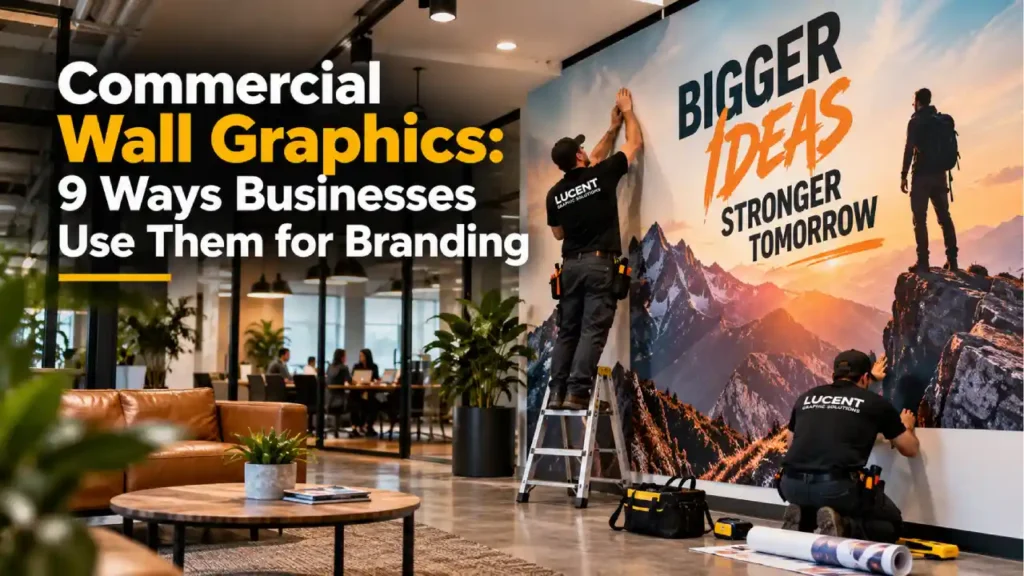
Measure every wall on site and note outlets, switches, and trim.
Test adhesion on a small patch of the existing paint.
Approve a printed color proof viewed under your building’s own lighting.
Print and trim panels with seams planned away from faces and logos.
Clean and prep the wall surface on the day of installation.
Install the panels, then walk the wall together to check edges and seams.
A single feature wall usually takes four to eight hours to install, and multi-wall projects typically take one to three days. We schedule evenings and weekends for offices and stores that can’t close during the day.
How much do commercial wall graphics cost in Orange County?
In Lucent’s pricing, standard vinyl wall graphics in Orange County ran $15 to $23 per square foot. A single 100-square-foot feature wall with design and installation came to about $1,500 to $2,300, and larger corporate lobby projects ran $5,000 to $15,000 depending on scale and material. Our breakdown of wall wrap costs for Orange County businesses has more examples.
Four things move the price most: total square footage, the material, the wall texture, and access. A two-story lobby that needs a lift costs more to install than the same artwork on an 8-foot office wall, and brick, stucco, or concrete need high-tack film and extra labor. Material prices change, so ask for a current written quote before you set a budget.
Final Words
Pick one wall to start. Walk through your office, store, or clinic and find the wall people see most, then photograph it straight on with a tape measure in the frame. Add rough measurements, the paint condition, and whether you lease or own the building. With those details we can tell you which material fits, whether you need removable film, and roughly what the wall will cost before any design work begins. Send them through our contact page, call (877)582-3680, or email info@lucentgraphicsolutions.com, and we’ll arrange a site visit anywhere in Orange County.
Lifespan depends on the material, the wall surface, and how often people touch it. Wallcovering in low-contact areas usually stay in place for years, while removable promo film is made for shorter runs. Ask for the film maker’s rated indoor life before you order.
Can commercial wall graphics be removed without damaging the wall?
Usually, no. Once a wall graphic has been installed for more than 12 months, the adhesive tends to become more permanent, and removal may result in paint or surface damage. For temporary applications, however, there are removable wall graphic materials specifically designed for short-term use. These are a better option when the graphic will need to be removed or replaced within a relatively short period.
Can wall graphics go on brick, concrete, or other textured walls?
Yes. Textured walls need a high-tack film that is heated and pressed into the surface. Installation takes longer than on smooth drywall, so labor costs more, and crumbling or very rough walls may need prep first.
Are commercial wall graphics safe to use in healthcare facilities?
Yes, with the right materials. Use low-emission printed graphics, a laminate that tolerates daily disinfectant wiping, and finish ratings your facility’s safety officer approves. Keep required ADA room signs separate from the decorative graphics.
What is the difference between a wall mural and wall lettering?
A wall mural is a full-color printed image covering most or all of a wall. Wall lettering is cut vinyl text or a simple logo in one or two colors. Lettering costs less and suits values statements and room names.
How long does it take to install commercial wall graphics?
A single feature wall usually takes four to eight hours to install. Multi-wall office or retail projects typically take one to three days. Design and proof approval come first, and printing starts once you sign off on the proof.
About Lucent
Graphic Solutions
We help businesses transform spaces and inspire people through custom wall graphics, wall lettering and branded environments.
 (877) 582 3680